About Indian Birds
Q. What is the largest Indian bird, and what the smallest ?
A. It is not easy to say which particular one is the largest, but amongst the upper ten are certainly the Sarus Crane and the Himalayan Bearded Vulture or Vulture or Lammergeyer . The former stand the height of a man; the latter has a wing spread of over 8feet. Amongst our smallest birds are the flowerpeckers , e.g. Tick ell's Flowerpeckers scarcely bigger than a normal thumb.
Q. What is our most beautiful bird ?
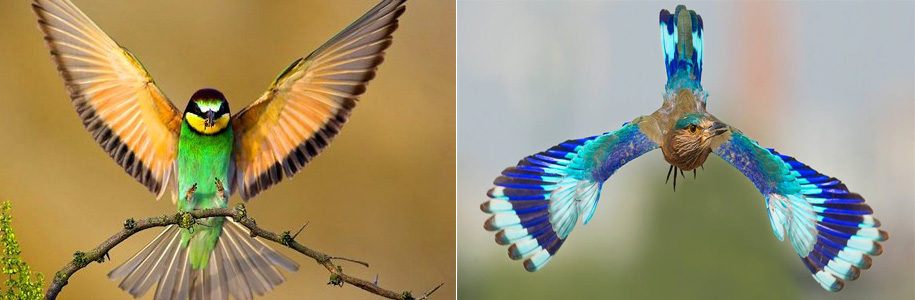
A. Difficult to pick out any single species for the highest honor, and depends rather on individual tastes. A large number of birds of many different families, particularly those resident in areas of humid evergreen forest, possess extraordinarily brilliant plumage .and adornment possessed by the cocks of most species . At the bottom of the size of the House sparrow or less – whose glistening resplendent plumage scintillating in the bright sunshine as they flit from flower to flower, or dart from one forest glade to another, transforms them into living gems.
Q. What is our commonest bird, and what our rarest ?
A. The answer depends largely on what part of the country you live in. But for India as a whole perhaps the House Crow and the House sparrow would be hard to beat for commonness and abundance. They had followed Man—everywhere –up in the hills and out in the desert—wherever his ingenuity has created loveable conditions for himself. Next in abundance come birds like Mynas and Bulbuls which though not wholly communal on Man are yet quick to profit by his presence and activities.
Q. Do Birds have a language?
A. They certainly have, if by language is meant that they can communicate with and understand one another. It consists not of speech as we know it, but of simple sounds and actions and enables birds-especially the more sociable ones---to maintain contact amongst themselves and convey simple reactions such as those of pleasure, threat, alarm, invitation, and others. Several of these signals--vocal, behavioral, or a combination of the two--are understood not only by members of the same species but also by other birds generally, e.g. the alarm notes and behavior of many on the approach of a marauding hawk. To this extent Man can also claim to understand the language of birds; Solomon himself could hardly have done more. But the structure of the bird's brain suggests a comparatively low level of intelligence and precludes the possibility of their holding regular conversations or expressing views and opinions as we humans are usually so ready to do!
Q. What is our most accomplished songster and talker?
A. Personally, for song I would give he palm to the Grey winged Blackbird (Turdus boulboul) of the Himalayas. A number of its close relations, members of the Thrush family, including the Malabar Whistling-Thrush and the White-rumped Shama follow close on its heels. The best talker amongst our Indian birds is certainly the Common Hill-Myna whose articulation of the human voice and speech is infinitely clearer and truer than that of the parakeets. The latter enjoy a wider reputation and are more generally kept as cage birds because they can more readily procured.
Q. How long does a bird live?
A. The age-potential, or the age to which a bird is capable of living, of course varies according to species and the environment and conditions under which its lives. Reliable data concerning the life span of wild birds in a state of nature are very difficult to obtain. It is only possible by the method of marking individual birds, particularly as nestlings. Most of the figures of age available are from birds in captivity and therefore living under somewhat unnatural conditions. An ostrich in captivity has lived for 40 years, a raven to 69 and another to 50. Passerine birds of about Sparrow size have occasionally reached 25 years, although normally their span is 5 to 8. A vulture attained 52, a horned owl 68, swan 25, pigeon 22 to 35, peacock 20. The longest lived birds in a natural state, as determined by the marking method, are: herring gull 36 years, oriole 8, pintail duck at least 13, grey heron about 16, blackbird 10, curlew 31-1/2, kite 25-3/4, and swallow 16+.